Single-mode fiber

Optical fiber types
Fiber with a core diameter less than about ten times the wavelength of the propagating light cannot be modeled using geometric optics. Instead, it must be analyzed as an electromagnetic structure, by solution of Maxwell's equations as reduced to the electromagnetic wave equation. The electromagnetic analysis may also be required to understand behaviors such as speckle that occur when coherent light propagates in multi-mode fiber. As an optical waveguide, the fiber supports one or more confined transverse modes by which light can propagate along the fiber. Fiber supporting only one mode is called single-mode or mono-mode fiber.
The behavior of larger-core multi-mode fiber can also be modeled using
the wave equation, which shows that such fiber supports more than one
mode of propagation (hence the name). The results of such modeling of
multi-mode fiber approximately agree with the predictions of geometric
optics, if the fiber core is large enough to support more than a few
modes.
The waveguide analysis shows that the light energy in the fiber is
not completely confined in the core. Instead, especially in single-mode
fibers, a significant fraction of the energy in the bound mode travels
in the cladding as an evanescent wave.
The most common type of single-mode fiber has a core diameter of 8–10 micrometers and is designed for use in the near infrared.
The mode structure depends on the wavelength of the light used, so that
this fiber actually supports a small number of additional modes at
visible wavelengths. Multi-mode fiber, by comparison, is manufactured
with core diameters as small as 50 micrometers and as large as hundreds
of micrometers. The normalized frequency V for this fiber should be less than the first zero of the Bessel function J0 (approximately 2.405).
Special-purpose fiber
Some special-purpose optical fiber is constructed with a
non-cylindrical core and/or cladding layer, usually with an elliptical
or rectangular cross-section. These include polarization-maintaining fiber and fiber designed to suppress whispering gallery mode
propagation. Polarization-maintaining fiber is a unique type of fiber
that is commonly used in fiber optic sensors due to its ability to
maintain the polarization of the light inserted into it.
Photonic-crystal fiber
is made with a regular pattern of index variation (often in the form of
cylindrical holes that run along the length of the fiber). Such fiber
uses diffraction
effects instead of or in addition to total internal reflection, to
confine light to the fiber's core. The properties of the fiber can be
tailored to a wide variety of applications.
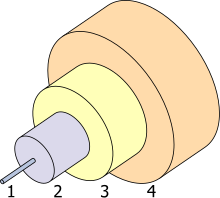
The structure of a typical single-mode fiber.
1. Core: 8 µm diameter
2. Cladding: 125 µm dia.
3. Buffer: 250 µm dia.
4. Jacket: 400 µm dia.
1. Core: 8 µm diameter
2. Cladding: 125 µm dia.
3. Buffer: 250 µm dia.
4. Jacket: 400 µm dia.

Tidak ada komentar:
Posting Komentar