History
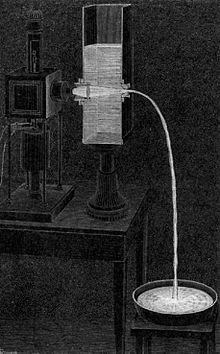
Daniel Colladon first described this “light fountain” or “light pipe” in an 1842 article titled On the reflections of a ray of light inside a parabolic liquid stream. This particular illustration comes from a later article by Colladon, in 1884.
Guiding of light by refraction, the principle that makes fiber optics possible, was first demonstrated by Daniel Colladon and Jacques Babinet in Paris in the early 1840s. John Tyndall included a demonstration of it in his public lectures in London, 12 years later.[3] Tyndall also wrote about the property of total internal reflection in an introductory book about the nature of light in 1870:
When the light passes from air into water, the refracted ray is bent towards the perpendicular... When the ray passes from water to air it is bent from the perpendicular... If the angle which the ray in water encloses with the perpendicular to the surface be greater than 48 degrees, the ray will not quit the water at all: it will be totally reflected at the surface.... The angle which marks the limit where total reflection begins is called the limiting angle of the medium. For water this angle is 48°27', for flint glass it is 38°41', while for diamond it is 23°42'.[4][5]
Unpigmented human hairs have also been shown to act as an optical fiber.[6]
Practical applications, such as close internal illumination during
dentistry, appeared early in the twentieth century. Image transmission
through tubes was demonstrated independently by the radio experimenter Clarence Hansell and the television pioneer John Logie Baird in the 1920s. The principle was first used for internal medical examinations by Heinrich Lamm
in the following decade. Modern optical fibers, where the glass fiber
is coated with a transparent cladding to offer a more suitable refractive index, appeared later in the decade.[3] Development then focused on fiber bundles for image transmission. Harold Hopkins and Narinder Singh Kapany at Imperial College
in London achieved low-loss light transmission through a 75 cm long
bundle which combined several thousand fibers. Their article titled "A
flexible fibrescope, using static scanning" was published in the journal
Nature in 1954.[7][8] The first fiber optic semi-flexible gastroscope was patented by Basil Hirschowitz, C. Wilbur Peters, and Lawrence E. Curtiss, researchers at the University of Michigan,
in 1956. In the process of developing the gastroscope, Curtiss produced
the first glass-clad fibers; previous optical fibers had relied on air
or impractical oils and waxes as the low-index cladding material.
A variety of other image transmission applications soon followed.
In 1880 Alexander Graham Bell and Sumner Tainter invented the Photophone at the Volta Laboratory in Washington, D.C., to transmit voice signals over an optical beam.[9]
It was an advanced form of telecommunications, but subject to
atmospheric interferences and impractical until the secure transport of
light that would be offered by fiber-optical systems. In the late 19th
and early 20th centuries, light was guided through bent glass rods to
illuminate body cavities.[10] Jun-ichi Nishizawa, a Japanese scientist at Tohoku University, also proposed the use of optical fibers for communications in 1963, as stated in his book published in 2004 in India.[11]
Nishizawa invented other technologies that contributed to the
development of optical fiber communications, such as the graded-index
optical fiber as a channel for transmitting light from semiconductor
lasers.[12][13] The first working fiber-optical data transmission system was demonstrated by German physicist Manfred Börner at Telefunken Research Labs in Ulm in 1965, which was followed by the first patent application for this technology in 1966.[14][15] Charles K. Kao and George A. Hockham of the British company Standard Telephones and Cables (STC) were the first to promote the idea that the attenuation in optical fibers could be reduced below 20 decibels per kilometer (dB/km), making fibers a practical communication medium.[16]
They proposed that the attenuation in fibers available at the time was
caused by impurities that could be removed, rather than by fundamental
physical effects such as scattering. They correctly and systematically
theorized the light-loss properties for optical fiber, and pointed out
the right material to use for such fibers — silica glass with high
purity. This discovery earned Kao the Nobel Prize in Physics in 2009.[17]
NASA used fiber optics in the television cameras that were sent to the moon. At the time, the use in the cameras was classified confidential,
and only those with sufficient security clearance or those accompanied
by someone with the right security clearance were permitted to handle
the cameras.[18]
The crucial attenuation limit of 20 dB/km was first achieved in 1970, by researchers Robert D. Maurer, Donald Keck, Peter C. Schultz, and Frank Zimar working for American glass maker Corning Glass Works, now Corning Incorporated. They demonstrated a fiber with 17 dB/km attenuation by doping silica glass with titanium. A few years later they produced a fiber with only 4 dB/km attenuation using germanium dioxide as the core dopant. Such low attenuation ushered in the era of optical fiber telecommunication. In 1981, General Electric produced fused quartz ingots that could be drawn into strands 25 miles (40 km) long.[19]
Attenuation in modern optical cables is far less than in electrical
copper cables, leading to long-haul fiber connections with repeater
distances of 70–150 kilometers (43–93 mi). The erbium-doped fiber amplifier,
which reduced the cost of long-distance fiber systems by reducing or
eliminating optical-electrical-optical repeaters, was co-developed by
teams led by David N. Payne of the University of Southampton and Emmanuel Desurvire at Bell Labs
in 1986. Robust modern optical fiber uses glass for both core and
sheath, and is therefore less prone to aging. It was invented by Gerhard
Bernsee of Schott Glass in Germany in 1973.[20]
The emerging field of photonic crystals led to the development in 1991 of photonic-crystal fiber,[21] which guides light by diffraction
from a periodic structure, rather than by total internal reflection.
The first photonic crystal fibers became commercially available in 2000.[22]
Photonic crystal fibers can carry higher power than conventional fibers
and their wavelength-dependent properties can be manipulated to improve
performance.

Tidak ada komentar:
Posting Komentar